
Math Solver Order of Operations | PEMDAS
Drag & drop a math image or document here, or click to upload
Supports: JPG, PNG, PDF, DOCX, PPTX
Detected Questions:
Review detected text
We couldn't read your handwriting perfectly. Edit the text below, then continue.
Practice Quiz
Choose a broad math topic to generate a 5-question quiz.
AI Video Lessons
Personalized video explanations will be available in a future update.
This premium feature will generate tailored video walkthroughs based on your current topic and familiarity level, across multiple languages.
Have you ever found yourself scratching your head after seeing a mathematical expression containing multiple parentheses, powers and different mathematical operators all in one expression? Solving such expressions becomes quite challenging especially if you do not know the basic mathematic rules like PEMDAS, BEDMAS, BODMAS, GEMDAS and MDAS.
Well, for this purpose our math solver order of operations tool stands out to help you solve all types of arithmetic problems including addition, subtraction, multiplication and division of positive, negative and exponential numbers. This tool also provides a clear step-by-step breakdown so that you can also learn which mathematical rule is implemented in different scenarios.
How Our PEMDAS Math Solver Works?
The functionality of our math solver order of operations tool is really user-friendly that involves just a few steps mentioned below.
Enter the Expression
Whatever the arithmetic expression you have, just simply type it or attach the screenshot / image of it in our math solver tool.
Click “Solve Problem” Button
After entering the question or attaching the image you will see the “Solve” button below. Just click on that and sit back.
View The Step-by-Step Breakdown
Our math solver order of operations tool will not only provide the answer but will also give you the detailed step-by-step breakdown of the solution steps.
Supported Operations of Our Math Solver
Our math Arithmetic solver tool can handle the following listed operations.
Operation | Symbol |
|---|---|
Addition | + |
Subtraction | – |
Multiplication | * |
Division | ÷ |
Exponents | ^ |
Roots | √ |
Parentheses | ( ) |
Curly Brackets | { } |
Square brackets | [ ] |
Fraction Bar | — |
Order of Operations Acronyms
PEMDAS is widely used in US, BEDMAS is more commonly used in UK and Canada while BODMAS is mostly used in Pakistan and India. MDAS is used when there are no powers or brackets while GEMDAS follows the same above concepts with a bit advanced naming.
Acronyms | Meanings |
|---|---|
PEMDAS | Parentheses, Exponents, Multiplication & Division, Addition & Subtraction |
BEDMAS | Brackets, Exponents, Division & Multiplication, Addition & Subtraction |
BODMAS | Brackets, Orders (Powers, Roots), Division & Multiplication, Addition & Subtraction |
GEMDAS | Grouping Symbols ((), {}, []), Exponents, Multiplication & Division, Addition & Subtraction |
MDAS | Multiplication, Division, Addition and Subtraction |
Arithmetic Operation Rules
Our math solver order of operations tool follows these simple rules for solving integers, addition, subtraction, multiplication and division
Rules For Adding Numbers (+)
In case of addition, 2 simple rules are followed:
- If signs are same then keep the sign and add the numbers
| (+) + (+) = + | (-) + (-) = (-) |
| (+3) + (+11) = +14 | (-7) + (-2) = -9 |
ii. If signs are different then keep the sign of the number with greater absolute value and subtract the smaller number from the bigger one
| (-Smaller) + (+Larger) = (+) | (+Smaller) + (-Larger) = (-) |
| (-2) + (+6) = +4 | (+4) + (-9) = -5 |
Rules For Subtracting Numbers (-)
For subtraction, a simple rule is followed with a slight change mentioned below.
The sign of first number remains unchanged and then we reverse the sign of number being subtracted so the positive number becomes negative and negative ones become positive. After this we apply the addition rules.
| (+) – (–) | (–) – (+) | (–) – (–) |
| (+7) – (–3) | (–8) – (+5) | (–2) – (–4) |
| = +10 | = –13 | = +2 |
Rules For Multiplying Numbers (* or x)
In case of multiplication, multiplying two numbers with same sign gives positive result while that for multiplying two numbers with different sign gives negative outcome.
| (+) * (+) = (+) | (–) * (–) = (+) | (+) * (–) = (–) | (–) * (+) = (–) |
| (+7) * (+4) = +28 | (–3) * (–2) = +6 | (+9) * (–6) = –54 | (–8) * (+9) = –72 |
Rules For Dividing Numbers (/ or ÷)
In case of division, the same multiplication rules are applied.
| (+) / (+) = (+) | (–) / (–) = (+) | (+) / (–) = (–) | (–) / (+) = (–) |
| (+8) / (+4) = +2 | (–20) / (–2) = +10 | (+9) / (–3) = –3 | (–10) / (+5) = –2 |
What is Math Solver Order of Operations Calculator?
Our math solver order of operations calculator is used to solve basic to complex mathematical expressions in sequential order following the mathematical set of rules like PEMDAS and others. This calculator helps us to untangle the problem one step at a time and solve the complex math problems step-by-step following rules of mathematics.
What is PEMDAS?
PEMDAS is a set of rules that are followed to solve a complex expression in a specific order. It is used to solve mathematical expressions like algebra, trigonometry, calculus, geometry and a lot more by remembering their correct order which is explained below.
Understanding Rules of PEMDAS
In arithmetic problems, there are different operators used and when all or most of them comes in one single expression then the PEMDAS rules are applied to them. These are simple set of rules to remember for solving such expressions in the correct order.
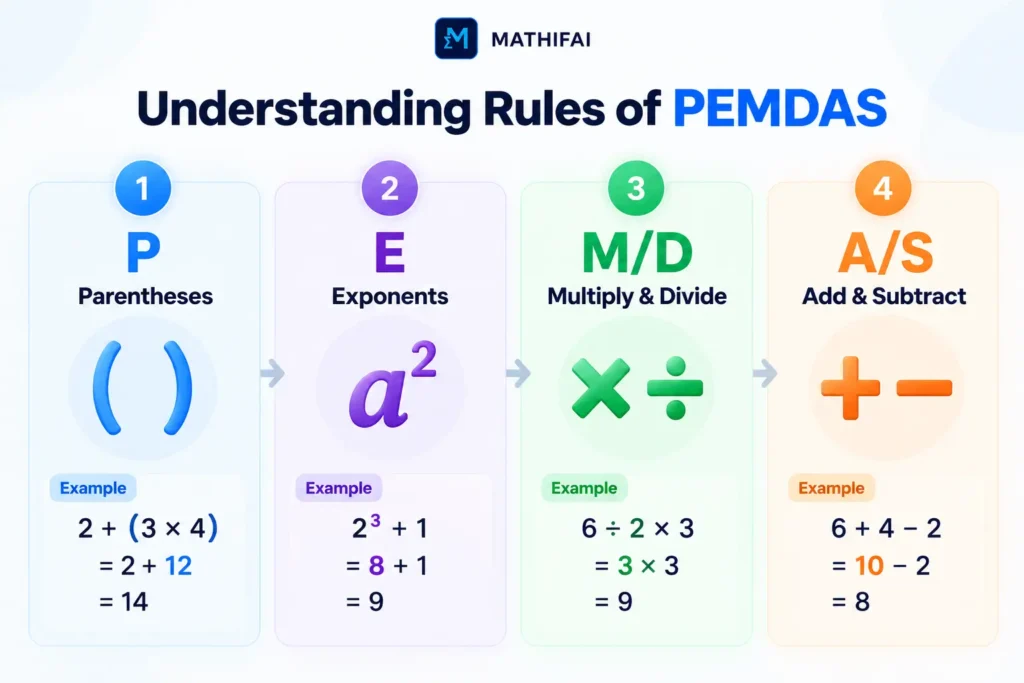
Rule 1:
If the expression contains parentheses then it has to be solved first before proceeding further.
Rule 2:
Then we have to check for exponents to solve if there are any of them present.
Rule 3:
Third rule applies to solve multiplication and division in the expression whichever comes first it has to be solved as most people confuse it by thinking that “MD” in PEMDAS specifically means to solve multiplication first. This is not true!
Rule 4:
Final rule states that we have to solve addition or subtraction present in the expression. And here also both are of equal importance so solve whichever comes first.
How To Simplify Equations With PEMDAS
Well let me tell you the funny version of PEMDAS first which says “Please Excuse My Dear Aunt Sally”. This is really a silly one but not bad as to remember the rule for yourself. Now let’s move towards the actual breakdown of PEMDAS which is:
Parentheses
Well these are kind of groups in the expression that needs to be solved on priority basis.
Example
Consider the expression
(2-6) * 5
Here parentheses part will be solved first and then the answer will be multiplied by 5
2-6 = -4
Now,
-4 * 5 = -20
Exponents
Exponents are the small power numbers that are present on the base numbers. After parentheses, look for numbers with exponents and solve them.
Example
(5)3 + 2
Firstly, solve the exponent.
53 = 5 x 5 x 5 = 125
Now add 2 in this result
125 + 2 = 127
Multiplication and Division
Now comes the turn of multiplication and division. But remember, “MD” in PEMDAS doesn’t mean that multiplication will always be performed before division. They have equal importance so work on them from left to right whichever comes first.
Example
In the expression
20 ÷ 5 x 3
Since, division comes first so we will solve that first which means 20 ÷ 5 which is equal to 4.
Now multiply this answer with 3 i.e. 4 x 3 = 12
Final answer is 12 after solving the expression in a proper sequence.
If the sequence was not followed then we would have done multiplication first getting the answer as 15 and then after performing division which would be 20 ÷ 15
The final answer would be then 4/3 which is not correct.
Addition and Subtraction
After “MD” look for “AS” means the addition and subtraction. But similar to “MD”, it does not mean that addition will always be performed before subtraction so follow the sequence of solving left to right here as well whichever comes first.
Example
Consider the expression
15 -2 + 5
First, subtract 2 from 15 which gives 13
Now add 5 in 13 to get the final answer
Final answer = 18
If we wouldn’t have followed the sequence of solving then our answer would be a different one and obviously wrong one.
2 + 5 = 7
Now, subtracting 7 from 15 will make the final answer as
15 – 7 = 8
This is wrong.
Example Calculations
For learning and practical purpose, let’s have a look over these examples that we are going to solve using proper arithmetic rules.
Example 1:
7 + 2 x (3 + 5) ÷ 4
Step 1: Solving parentheses
3 + 5 = 8
7 + 2 x (8) ÷ 4
Step 2: No Exponents So Multiplication and Division (Left To Right)
=) 2 x 8 = 16
7 + 16 ÷ 4
Now 16 ÷ 4 = 4
The expression becomes
7 + 4 = 11 Answer
Example 2:
(6 + 2)2 ÷ 4 – 3
Step 1: Solving parentheses
(6 + 2) = 8
It becomes (8)2 ÷ 4 – 3
Step 2: Solving Exponents
(8)2 = 64
It becomes 64 ÷ 4 – 3
Step 3: Multiplication and Division (Left To Right)
64 ÷ 4 = 16
It becomes 16 – 3
Step 4: Addition and Subtraction (Left To Right)
16 – 3 = 13 Answer
Example 3:
(7 – 3)2 +12 ÷ 4
Step 1: Solving parentheses
7 – 3 = 4
It becomes (4)2 +12 ÷ 4
Step 2: Solving Exponents
(4)2 = 4 x 4 = 16
It becomes 16 +12 ÷ 4
Step 3: Multiplication and Division (Left To Right)
12 ÷ 4 = 3
It becomes 16 + 3
Step 4: Addition and Subtraction (Left To Right)
16 + 3 = 19 Answer
Common Mistakes People Make While Solving
- They think multiplication always comes first before division and addition always comes first before subtraction which we have discussed above that it is not the correct approach
- Mostly people start solving expressions from left to right without looking for parentheses or exponents
- Many people make mistakes while solving mathematical expressions just because they do not know the rules and order of solving such expressions
Learn, Do Not Just Solve
The purpose of our math solver order of operations tool is to help you double-check your solution steps, get help when you are stuck, see where you go wrong and how to resolve your errors. It is meant to help you learn and grow, and not just getting the solutions.